
Introduction
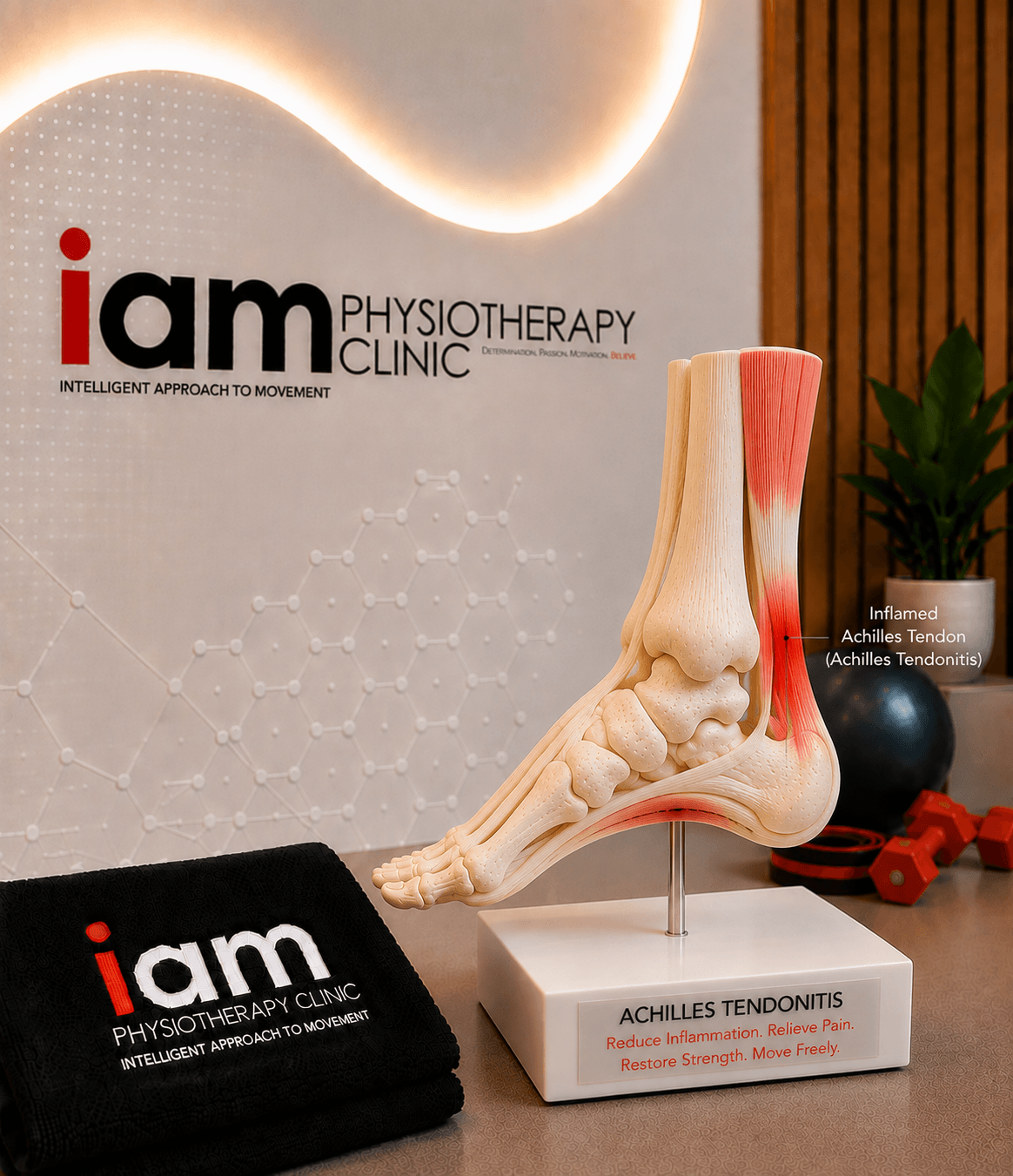
Understanding Achilles Tendonitis
plays an important role in walking, running, jumping, climbing stairs, and pushing the body forward during movement.
Achilles tendonitis is commonly used to describe pain and irritation involving the Achilles tendon. In many longer-lasting cases, the condition is more accurately described as Achilles tendinopathy, which can involve changes in the tendon related to repeated loading. Symptoms may develop gradually or occur after a sudden increase in running, sports, exercise, or other physical activity.
Common symptoms include pain or stiffness at the back of the ankle, tenderness around the Achilles tendon, discomfort during walking or running, and stiffness after periods of rest. Without appropriate rehabilitation, symptoms may interfere with exercise, sports participation, and everyday movement.
At IAM Physiotherapy Clinic in Newmarket, our physiotherapists assess your Achilles tendon, calf strength, ankle mobility, balance, walking and running mechanics, activity levels, and training patterns. Based on your assessment, we create a personalised rehabilitation program that may include progressive strengthening, mobility exercises, manual therapy where appropriate, activity modification, balance training, and a gradual return-to-sport program.
We proudly support patients across Newmarket, Aurora, Bradford, East Gwillimbury, Richmond Hill, and York Region with individualised physiotherapy designed to improve tendon function and support a confident return to activity.
-
Call
(289) 466-1140 -
Email
[email protected]
Causes
Common Achilles & Lower-Leg Conditions We Treat
Our physiotherapists in Newmarket help patients manage Achilles tendonitis and related lower-leg, ankle, and foot conditions that may affect movement and physical activity.
- Achilles Tendonitis
Pain and irritation around the Achilles tendon can affect walking, running, jumping, and other activities that place repeated demands on the tendon.
- Achilles Tendinopathy
Longer-lasting Achilles tendon symptoms may be associated with changes in the tendon’s ability to tolerate and adapt to repeated loading.
- Achilles Tendon Pain
Pain may occur along the middle portion of the Achilles tendon or closer to where the tendon attaches to the heel.
- Calf Muscle Tightness
Reduced calf flexibility or mobility may affect ankle movement and contribute to increased demands on the Achilles tendon during activity.
- Calf Muscle Weakness
Reduced calf strength can affect the ability of the lower leg and Achilles tendon to manage walking, running, jumping, and other physical loads.
- Running-Related Achilles Pain
Changes in running distance, speed, frequency, hills, surfaces, footwear, or training intensity may increase the demands placed on the Achilles tendon.
- Sports-Related Achilles Injuries
Sports involving running, jumping, sprinting, or rapid changes in direction can place significant demands on the Achilles tendon.
- Ankle Mobility Restrictions
Reduced ankle mobility can influence lower-limb mechanics and may affect how loads are distributed through the foot, ankle, calf, and Achilles tendon.
Approach
How We Support Achilles Tendonitis Recovery
At IAM Physiotherapy Clinic, we create individualised rehabilitation programs based on your symptoms, tendon capacity, activity level, physical assessment, and recovery goals.
- Comprehensive Achilles & Ankle Assessment
Our physiotherapists assess your Achilles tendon, calf strength, ankle mobility, balance, movement patterns, and activity levels to identify factors that may be contributing to your symptoms.
- Pain & Load Management
We provide guidance on modifying activities and managing tendon loading to help reduce excessive stress while maintaining appropriate movement and physical activity.
- Progressive Tendon Strengthening
Progressive strengthening exercises can help improve the capacity of the calf and Achilles tendon to tolerate everyday, recreational, and athletic demands.
- Calf Strengthening
Targeted calf exercises can help restore strength and endurance needed for walking, running, jumping, stair climbing, and sports.
- Ankle Mobility Exercises
Where appropriate, mobility exercises can help address ankle restrictions that may affect movement and load distribution through the lower limb.
- Balance & Movement Training
Balance and control exercises can help improve ankle stability and lower-limb coordination during functional and athletic activities.
- Return-to-Running & Sports Rehabilitation
Your physiotherapist can gradually progress running, jumping, sports, and other activities according to your symptoms, strength, and ability to tolerate increasing loads.
WHY CHOOSE IAM PHYSIOTHERAPY CLINIC
Why Patients Choose IAM Physiotherapy Clinic for Achilles Tendonitis Rehabilitation
Patients across Newmarket and York Region choose IAM Physiotherapy Clinic for individualized physiotherapy programs designed to address Achilles tendon pain, calf weakness, ankle mobility restrictions, and sports-related lower-limb problems.
- Experienced Physiotherapy Team
Our physiotherapists use evidence-based assessment and rehabilitation strategies to help address Achilles tendon problems and related foot and ankle conditions.
- Personalised Treatment Programs
Every treatment plan is adapted to your symptoms, physical condition, activity level, lifestyle, and individual recovery goals.
- Progressive Rehabilitation
We use a gradual approach to strengthening and activity progression to help improve the ability of the Achilles tendon and surrounding muscles to manage physical demands.
- Focus on Functional Recovery
Our goal is to help you regain strength, mobility, balance, and confidence so you can return to everyday activities, exercise, running, and sports.
Signs That Should Not Ignore
Signs You May Benefit from Achilles Tendonitis Physiotherapy
Consider scheduling a physiotherapy assessment if you experience:
- Pain at the back of the ankle
- Achilles tendon stiffness in the morning
- Pain when walking or climbing stairs
- Achilles pain during running
- Discomfort during jumping or sports
- Tenderness around the Achilles tendon
- Calf weakness
- Reduced ankle mobility
- Pain after increasing physical activity
- Difficulty returning to running
- Recurring Achilles tendon pain
- Reduced ability to participate in sports or exercise
You do not need to wait until Achilles tendon pain becomes severe. An assessment can help identify contributing factors and provide a progressive rehabilitation plan based on your symptoms, activity level, and recovery goals.
Importance Of Foot Physiotherapy
Benefits of Achilles Tendonitis Physiotherapy
A personalized Achilles tendon rehabilitation program can help support:
- Reduced Achilles tendon pain
- Improved calf strength
- Improved tendon load tolerance
- Better ankle mobility
- Improved balance and stability
- Better lower-limb movement control
- Improved walking ability
- Increased exercise tolerance
- Safer return to running
- Gradual return to sports
- Improved confidence with physical activity
- Better management of training loads
- Reduced risk of recurring symptoms
- Improved overall lower-limb function
Why Choose
IAM Physiotherapy Clinic


The Next Evolution of Rehab
Precision Movement. Clinical Excellence.
At IAM Physiotherapy Clinic in Newmarket, we blend elite biomechanics with targeted spinal and musculoskeletal recovery. We don’t just treat symptoms—we optimize your body’s physical architecture so you can live without limits.
Book Appointment
Meet Our Award-Winning Team
A Multidisciplinary Team Dedicated to Your Health, Recovery, and Well-Being
At IAM Physiotherapy Clinic, our experienced and registered practitioners work together to deliver personalized care that helps you move better, improve function, and maintain long-term wellness.


Patient Experiences
Real Stories. Real Recoveries.
See what patients say about their recovery journey at IAM Physiotherapy Clinic. Our commitment to expert care and personalized treatment has helped hundreds of patients regain mobility and improve their quality of life.


Expert Physiotherapy Care Starts Here
Book Your Physiotherapy Visit – Simple & Convenient
Our team is here to help you recover from injuries, reduce pain, and improve mobility. Book your appointment today and let our experienced team guide you toward lasting recovery.

Frequently Asked Questions
Arch Dysfunction Physiotherapy in Newmarket – FAQs
Achilles tendonitis is a term commonly used for pain and irritation involving the Achilles tendon at the back of the ankle. Longer-lasting Achilles tendon problems are often referred to as Achilles tendinopathy and may involve changes in the tendon’s response to repeated loading.
Common Achilles tendonitis symptoms include pain or stiffness at the back of the ankle, tenderness around the Achilles tendon, morning stiffness, discomfort while walking or running, pain during jumping, and increased symptoms after physical activity.
Achilles tendon problems can develop when the demands placed on the tendon increase faster than its ability to adapt. Sudden increases in running or sports activity, changes in training intensity, repetitive jumping, calf weakness, reduced ankle mobility, and inadequate recovery may contribute to symptoms.
Yes. Achilles tendonitis physiotherapy can help improve tendon capacity, calf strength, ankle mobility, balance, and movement control. Treatment commonly includes progressive strengthening, load management, mobility exercises, and a gradual return-to-activity program.
Recovery time varies depending on the duration and severity of symptoms, tendon capacity, activity demands, and individual factors. Achilles tendon rehabilitation often requires gradual progression rather than simply resting until symptoms disappear.
Whether you can continue running depends on your symptoms, the severity of the condition, and your ability to tolerate the load. A physiotherapist can assess your condition and provide individualized guidance on activity modification, running volume, and a gradual return-to-running program.
Calf tightness may affect ankle movement and how forces are distributed through the lower leg and Achilles tendon. However, Achilles tendon pain can have multiple contributing factors, so an individual assessment is useful for determining the most appropriate treatment approach.
Rehabilitation exercises commonly focus on progressively strengthening the calf and Achilles tendon. Depending on your condition, exercises may include calf raises, progressive resistance exercises, balance training, and functional movements. Exercises should be selected and progressed according to your symptoms and physical assessment.
Consider seeing a physiotherapist if Achilles tendon pain persists, repeatedly returns, affects walking or running, causes morning stiffness, limits exercise, or prevents you from participating in sports. Early assessment can help identify contributing factors and establish an individualized rehabilitation plan.
Most extended health insurance plans cover physiotherapy treatment. iam Physiotherapy Clinic also offers direct billing for many insurance providers.
You can book your physiotherapy appointment online through iam Physiotherapy Clinic or contact our team directly for assistance.